
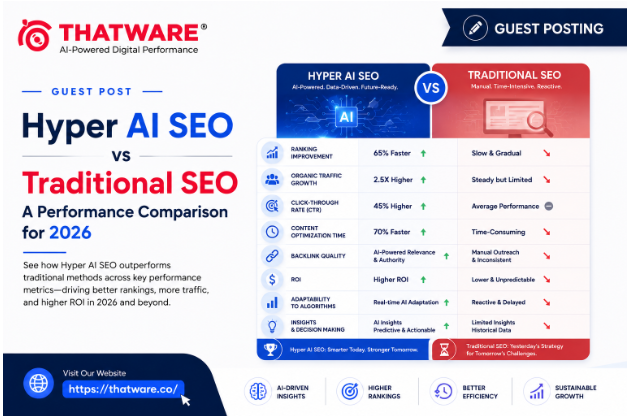
If you’ve been running a website for any length of time, you know the experience of doing everything right by the traditional SEO playbook — solid keyword research, clean technical structure, decent backlinks, reasonably good content — and watching your rankings plateau anyway. Sometimes even decline. And the frustrating part is that nothing “went wrong.” The site is fine. The competition just got better.
That’s the environment SEO operates in now. And it’s the exact environment that makes the comparison between Hyper AI SEO and traditional approaches worth taking seriously, rather than writing off as vendor marketing.
Setting Up a Fair Comparison
To make this meaningful, let’s be precise about what we’re comparing. Traditional SEO, as most agencies still practice it, involves: manual or tool-assisted keyword research, quarterly or monthly technical audits, human-authored content created around identified target terms, link acquisition through outreach, and performance monitoring via ranking trackers and analytics dashboards.
Hyper AI SEO, as implemented through frameworks like ThatWare’s, involves AI-driven semantic analysis at the entity and topic level, continuous technical triage prioritized by predicted ranking impact, machine learning-informed content briefs and optimization, behavioral signal analysis, and predictive modeling for ranking changes before they occur.
The difference isn’t just tools — it’s the fundamental model of how optimization decisions get made.
Speed to Impact
Traditional SEO timelines are well-documented and frankly frustrating: most clients see meaningful ranking movement in three to six months, with significant results often taking a year or longer in competitive verticals. This isn’t negligence — it’s the natural lag of manual work, slow feedback loops, and sequential optimization.
Hyper AI SEO vs traditional SEO analysis consistently shows compressed timelines with AI-powered approaches, particularly in the technical and content layers. When technical fixes are prioritized by predicted impact rather than crawl error volume, development sprints produce ranking movement faster because the right work gets done first. When content is guided by semantic analysis rather than keyword volume, pages enter competitive search results with more complete coverage of the topic space — which means less iteration required before they rank.
The compressing of feedback loops also matters. Traditional SEO often discovers that content is underperforming only after weeks of poor ranking data. AI-informed approaches can flag issues earlier — sometimes before a page fully indexes — based on signals that historically correlate with ranking difficulties.
Scale and Coverage
Here’s a comparison that rarely gets discussed honestly: coverage. A traditional SEO team can actively optimize a limited number of pages simultaneously. Realistically, even a well-resourced team might maintain active optimization across a few hundred pages at a time. For enterprise sites with tens or hundreds of thousands of pages, that means the vast majority of the site is perpetually unoptimized.
AI-powered systems can monitor and analyze an entire site continuously, flagging pages showing decay signals, identifying content gaps at scale, and prioritizing opportunities based on traffic potential and competitive difficulty — across all pages simultaneously. The floor of optimization quality across a large site lifts considerably when AI is managing triage.
Durability Through Algorithm Changes
This is perhaps the most practically important performance dimension. Traditional SEO is vulnerable to algorithm updates in a specific way: because it’s built around reverse-engineering current ranking signals, sites optimized purely for those signals can lose significant ranking positions when those signals change in weight.
AI SEO approaches that focus on genuine semantic authority, entity relevance, and comprehensive content coverage tend to be more durable — not because they’re immune to algorithm changes, but because they’re built around what search engines are trying to reward, not just what they currently appear to reward. When Google’s signals shift toward better reflecting user satisfaction, sites optimized for user satisfaction are already positioned correctly.
Return on Investment
The AI-driven SEO agency model typically costs more than traditional SEO retainers. It would be dishonest to pretend otherwise. The question is whether the ROI justifies the investment.
For businesses where organic traffic is a primary growth channel — ecommerce, SaaS, publishers, service businesses — the compounding nature of AI-driven results typically produces superior lifetime ROI. The value doesn’t come from paying less per month. It comes from achieving ranking positions that hold and improve over time, rather than requiring constant manual maintenance to sustain.
For businesses where organic traffic is secondary to paid channels or where budget constraints are significant, traditional SEO may still be the more practical choice. The performance gap is real, but so is the cost difference, and the right answer depends on the business context.
What’s clear heading into 2026 is that the gap is widening. Traditional SEO hasn’t become ineffective — but it’s becoming the floor, not the ceiling. Businesses that want to compete at the highest level of organic search performance increasingly need to operate at the level of sophistication that Hyper AI SEO frameworks provide.
The question isn’t whether AI-powered SEO outperforms traditional SEO. The data increasingly says it does. The question is whether your organic growth goals justify the investment to close the gap.
